HOA Gate Maintenance Contracts in DFW: What Should Be Covered and What to Watch Out For
HOA board members and property managers across DFW suburbs sign gate maintenance contracts every year without fully understanding what those contracts do and don't include. This guide covers what a proper contract looks like, the red flags hiding in low-bid proposals, and how Texas law shapes your obligations as an HOA.
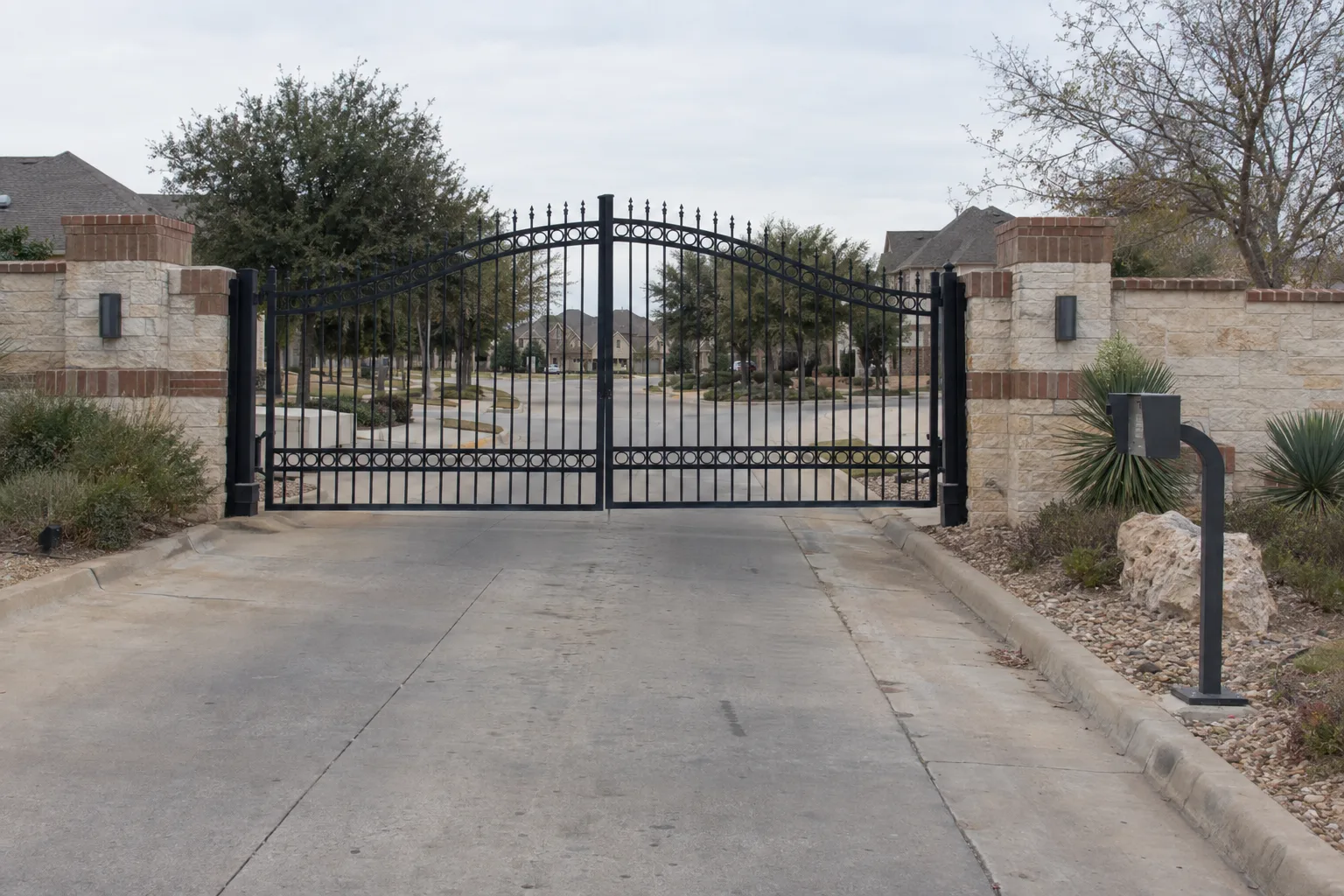
Quarterly inspections recommended per gate system per year
Emergency response availability for gated communities
Texas Property Code governing HOA gate obligations
What a Proper Gate Maintenance Contract Actually Includes
A gate maintenance contract is not just a schedule for oiling hinges. For gated communities in Coppell, Castle Hills, Riverchase, and comparable master-planned developments across DFW, the entry gate is the first layer of security. What happens when it fails at 2 a.m. matters.
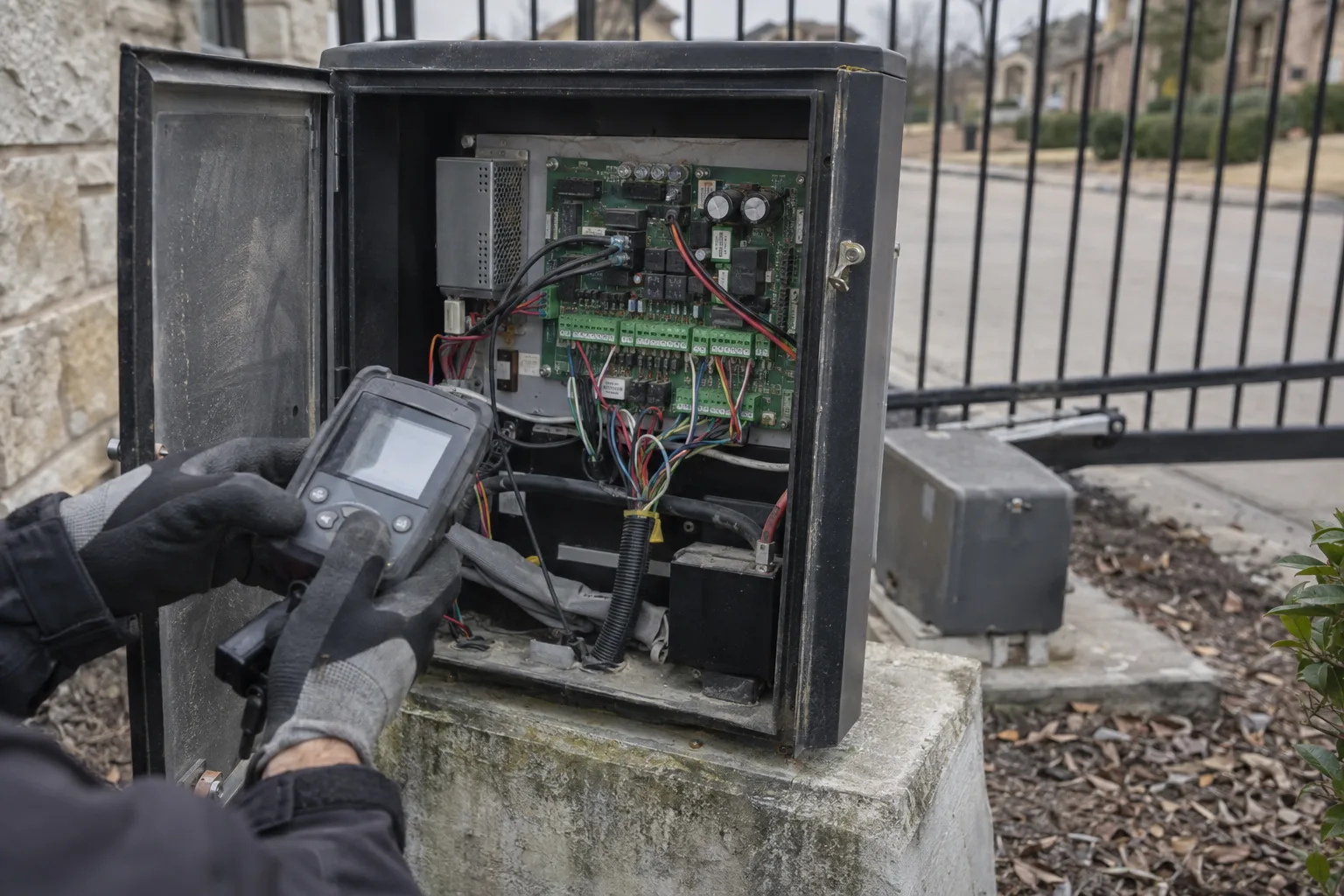
A contract worth signing covers four core areas. First, quarterly preventive inspections. At each visit, a technician should check the operator motor, control board, limit switches, safety reversals, entrapment protection devices, and the structural condition of the gate panel itself. Skipping any of these means small problems compound into costly repairs.
Second, loop detector checks. Underground vehicle detection loops lose sensitivity over time, especially in Texas heat where asphalt expands and contracts. If a loop reads poorly, the gate may not open for residents or may close on a vehicle. This check should be part of every inspection visit, not an add-on.
Third, a clear emergency response SLA. The contract should state, in hours not vague language, how quickly a technician will be on-site after an after-hours call. For communities where the gate is the only controlled entry point, a four-hour response window is the maximum that makes operational sense.
Parts Warranty and Labor Terms
Fourth, parts warranty and labor terms. Low-cost contracts often cover labor only, leaving the HOA to absorb parts costs when a control board or motor goes out. A well-structured agreement distinguishes between wear items (springs, drive belts) that are expected to need periodic replacement, and operator components that should carry at least a one-year parts warranty.
For solar-powered gate systems, which are increasingly common in newer DFW subdivisions, battery bank condition and charge controller function should also appear on the inspection checklist. See our overview of solar gate access control systems for what ongoing maintenance looks like there specifically.
Access Control System Coverage
Access control systems, keypads, intercoms, and RFID readers should be listed in the contract scope. Many vendors exclude these entirely and treat them as separate billable work. If your community uses a telephone entry system, confirm explicitly whether software updates and cellular connectivity are included.
Our commercial gate maintenance contracts for HOAs address all of these items in writing before any agreement is signed.
What Low-Bid Contracts Usually Leave Out
Price is not the reliable signal boards think it is. The cheapest proposal almost always omits something, and what it omits is usually what costs the most when things go wrong.
Vague response times are a common issue. Phrases like "we respond promptly" or "service within a reasonable timeframe" have no enforceable meaning. If a contract does not specify a numeric SLA, the HOA has no leverage when a gate is stuck open over a holiday weekend.
Exclusion of safety compliance is another issue. UL 325 is the industry safety standard for gate operators. Some vendors will service the mechanical components but will not test or certify that entrapment protection zones, safety edges, and photo-eye reversals meet current UL 325 requirements. This leaves the HOA exposed to liability if a resident or guest is injured.
No itemized inspection checklist
If a contract says "routine maintenance" without detailing what that includes, you cannot verify whether any work was done or which components were actually checked.
Automatic renewal with no exit clause
Short renewal notice windows, sometimes as few as 30 days, combined with auto-renewal language can lock a community into a vendor relationship long after the board wanted to switch.
No documentation left after each visit
Every service visit should produce a written report or digital record. Without it, the board has no audit trail and no way to track whether quarterly inspections actually happened.
Subcontracting without disclosure
Some gate companies pass work to whoever is available on a given day. Boards should ask directly whether technicians are employees or subcontractors, and whether the company carries workers' compensation insurance on site crews.
Texas HOA Law and Gate Safety Obligations
Texas Property Code Chapter 204 governs property owners' associations in subdivisions and gives HOAs the authority to maintain and regulate common areas, including entry gates. What Chapter 204 does not do is specify the technical standard for how gates must be maintained. That gap is where liability risk lives.
An HOA that controls a vehicle gate has a duty to keep it in reasonably safe operating condition. If a gate closes on a vehicle because the loop detector was malfunctioning and the HOA had deferred maintenance, that is a premises liability exposure. Courts will look at whether the association acted reasonably, and a lapsed or superficial maintenance contract works against that argument.
The Texas Department of Insurance does not regulate gate operators specifically, but the HOA's own general liability policy typically requires that common-area equipment be maintained in good working order. Some insurers now ask specifically about gate maintenance documentation during underwriting. Boards that cannot produce service records may face higher premiums or coverage questions.
For communities that installed their gates before current UL 325 entrapment protection requirements were in place, there is no mandatory retrofit deadline in Texas. That said, if a gate injures someone and the HOA was aware the safety systems were outdated, the awareness itself becomes a factor in any subsequent claim. Proactive documentation of known deficiencies, along with a plan to address them, is better than silence.
The Texas Department of Licensing and Regulation oversees many trades and can be a resource for verifying contractor license status. The Community Associations Institute also publishes guidance on HOA vendor contract best practices.
Texas Property Code
Governs HOA authority over common areas including entry gates across Texas subdivisions.
Industry Safety Standard
The standard for gate operators covering entrapment protection zones, safety edges, and photo-eye reversals.
Typical inspection interval
Recommended cycle for quarterly preventive inspections in active DFW gated communities.
DFW Communities Where This Comes Up Most
Not every neighborhood in DFW deals with these questions at the same scale. Master-planned communities with controlled vehicle access, multiple gate points, and active HOA boards face this more acutely than smaller subdivisions with a single pedestrian access code.
In Coppell, many of the older gated entries were installed in the late 1990s and early 2000s. Operators from that era are at or past typical service life, and boards are increasingly facing the question of whether to repair aging equipment under a contract or budget for full replacement. The answer depends on parts availability for the specific operator brand and how many components have already been replaced. Our page on automatic driveway gate repair covers that repair-vs-replace question in more detail.
Castle Hills in Lewisville and Carrollton has several active gated sections with high traffic counts. High-cycle applications wear out operator components faster than standard residential settings. Contracts for these entries should specify a higher inspection frequency, or at least a mid-year follow-up, not just quarterly visits.
Riverchase in Coppell has similarly dense gate usage during peak commute hours. Boards there have found that the best contracts include a provision for technician response during business hours, not just after-hours emergency calls, because daytime gate malfunctions affect resident access to and from work.
Communities along the SH-121 corridor in Flower Mound, Grapevine, and Southlake often have newer gate systems, but newer does not mean maintenance-free. Newer operators have more electronics, and electronics in outdoor DFW conditions, extreme heat, storm surges, and occasional ice, have failure modes that quarterly inspection catches before it becomes a service call.
If your community has a solar-powered gate system, maintenance requirements are somewhat different. Battery banks in Texas heat degrade faster than manufacturer ratings assume. See our guide on DIY vs professional solar gate opener installation for a realistic picture of ongoing upkeep.
How to Evaluate a Gate Maintenance Proposal Before Signing
Boards rarely have a gate technician on staff. That makes it hard to evaluate competing proposals on technical merit. A few concrete questions level that information gap.
Ask for a sample inspection report from an actual past visit, with identifying details redacted if needed. A vendor who can provide this is one who actually produces documentation. A vendor who cannot is one who does not.
Ask specifically what is excluded from the contract. Every contract has exclusions. The question is whether those exclusions are reasonable wear items or whether they exclude the major components most likely to fail. A contract that excludes control boards and operators is essentially a contract to watch your gate.
Ask about insurance. The vendor should carry general liability and workers' compensation. Request certificates directly, not verbal assurances. A vendor who hesitates or cannot produce current certificates within a day or two is one to be cautious about.
Ask who handles calls at 2 a.m. The answer should be a direct line to a dispatcher or on-call technician, not a voicemail box. Test the number before signing. Our gate and garage door FAQ covers many of the technical questions boards ask at this stage.
Itemized Inspection Checklist
Every visit should cover the operator motor, control board, limit switches, safety reversals, entrapment protection devices, loop detectors, and gate panel condition. Not just "general maintenance."
Numeric Emergency SLA
Response time should be stated in hours, not phrases. For gated communities with a single controlled entry, four hours after-hours is a reasonable ceiling. Less is better.
Written Post-Visit Reports
Documentation after each service visit creates an audit trail. This protects the HOA in liability situations and gives the board a way to verify that quarterly inspections actually occurred.
Parts Warranty Terms
Distinguish between wear items that are expected to need replacement and operator components that should carry at least a one-year parts warranty. Get this in writing, not verbal assurances.
UL 325 Safety Compliance
Entrapment protection, safety edges, and photo-eye reversals should be tested at each visit against current UL 325 standards. Confirm this is in scope, not an optional add-on billed separately.
Clear Exit and Renewal Terms
Know exactly when you must notify the vendor to avoid auto-renewal. 60-day written notice is a common industry standard. Anything less than 30 days is a red flag worth negotiating before signing.
Questions Boards Frequently Ask About Gate Contracts
The following covers the specific questions HOA boards and property managers ask most often when evaluating or renegotiating gate maintenance agreements.
How often should gate inspections happen?
Quarterly is the industry standard for active gated communities. High-cycle applications, such as main entries with hundreds of vehicle passes per day, may warrant a mid-year check between quarters. Annual-only contracts are inadequate for most DFW communities.
Should the HOA own the operator or is it common to lease?
Most HOAs own their gate operators outright. Lease arrangements do exist but are less common. If a vendor proposes a lease, understand who is responsible for repairs and replacements and what happens to the equipment at lease end.
Does a maintenance contract cover vandalism damage?
Standard maintenance contracts do not cover vandalism. That falls under the HOA's property insurance. However, a maintenance contractor who responds after-hours to a vandalism event should be clearly covered for that visit under the emergency response terms, even if the repair itself is billed separately.
Can the HOA manage gate maintenance in-house?
Routine lubrication and visual checks are reasonable for on-site staff. Anything involving the operator electronics, control board programming, or safety system testing requires a technician with the proper equipment and liability insurance. In-house staff who attempt those repairs without credentials create exposure for the HOA.
Working With a Local Gate Contractor vs. a Regional Service Chain
HOA boards often receive proposals from both local contractors and larger regional companies. Each has trade-offs.
Large regional companies may have standardized contracts and more scheduling staff, but they also tend to dispatch technicians from wherever is available, which affects response time in a direct, practical way. A technician based in Fort Worth responding to a Coppell emergency at midnight is not in the same position as one based locally.
Local contractors know the specific gate models common in DFW communities, stock the parts more likely to be needed, and typically have shorter response times for communities within their primary service area. The trade-off is that a small contractor's capacity to cover multiple simultaneous emergencies is limited.
The practical answer for most boards is to evaluate the specific contractor, not the category. Ask what their actual average response time has been for after-hours calls in the past year. Ask how many communities they currently service and whether they have the capacity to add yours. Specifics beat category assumptions.
For communities evaluating custom driveway gate installation alongside a new service contract, the combination often results in better pricing and cleaner accountability than using two separate vendors. One contractor who installs and maintains the gate has full knowledge of the system and cannot point fingers at the installer when a warranty question arises.
Related Resources for HOA Boards
- → Gate Opener Installation and Repair - what to expect from operator service
- → Automatic Driveway Gate Repair - emergency service details and repair vs. replace guidance
- → Custom Driveway Gate Installation in Colleyville TX - local installation context
- → Garage Door Maintenance Service: What's Included and Why It Matters - comparable maintenance contract context
- → Areas We Service - full DFW coverage map
Get a Gate Contract Assessment
If your community is in Coppell, Carrollton, Lewisville, Flower Mound, or anywhere else in the DFW suburbs, we can review your current gate system and provide a proposal that covers what actually needs to be covered. No pressure, no boilerplate. A real assessment of your specific gate setup.
Our HOA gate service agreements and commercial gate maintenance for DFW communities are structured to address the specific requirements boards deal with, including documentation, SLA terms, and safety compliance.
Coppell Garage Door Pros
Serving Coppell, Carrollton, Lewisville, Flower Mound, Grapevine, Southlake, and surrounding DFW communities.
© 2026 Coppell Garage Door Pros. All rights reserved.